Drone Show Designer
WIPBrowser-based node editor for drone light shows: a typed ShowGraph as the single source of truth, live 3D preview on the main thread, deterministic bake with full physics validation in a Web Worker. Plus a Claude agent with 30+ tools working directly on the graph. Live at drones.prototyp.ms, under active development.
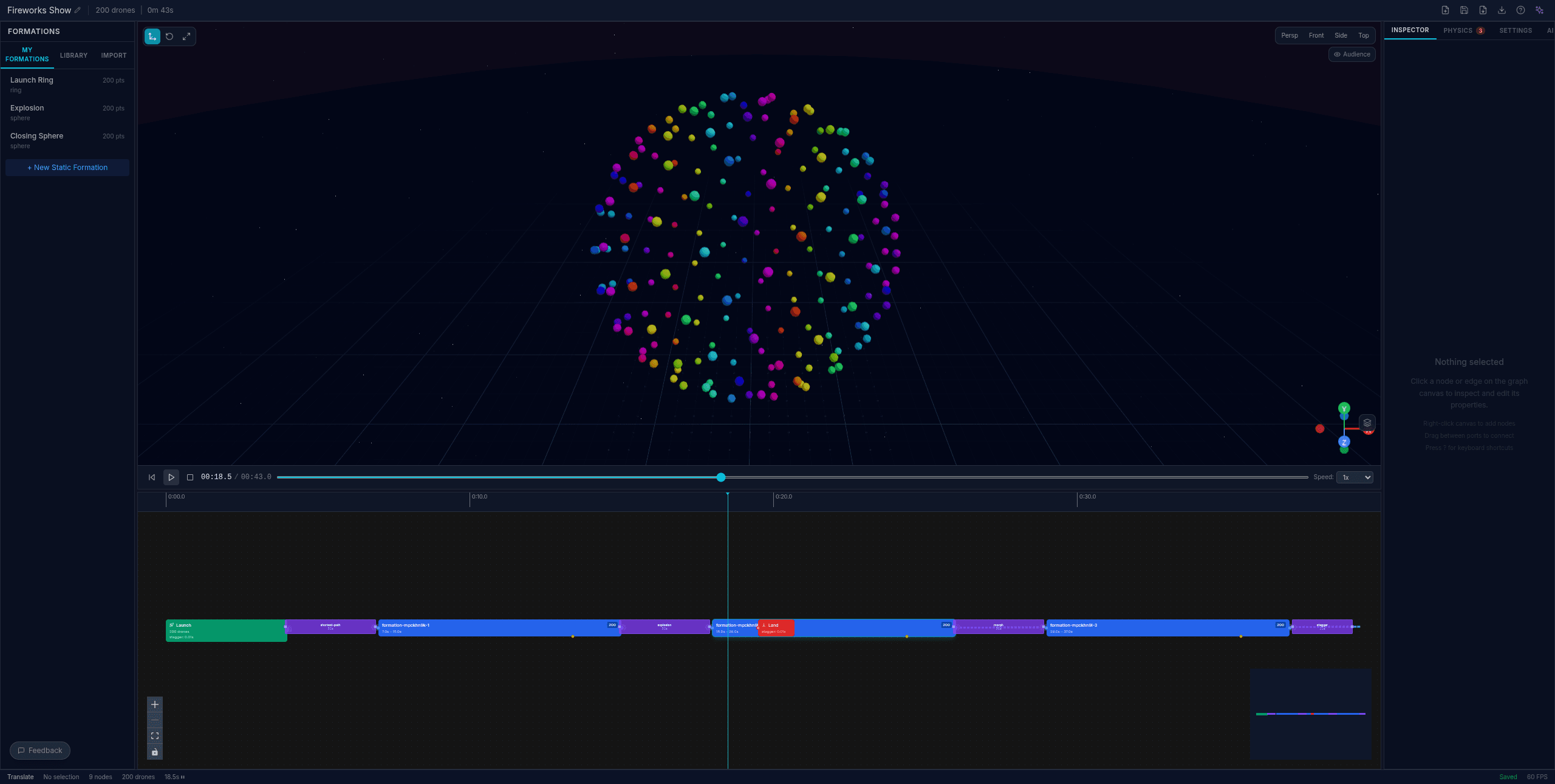
Drone-show choreography today is locked into Blender plugins and proprietary desktop apps: none of them collaboratively scriptable, none of them browser-editable, none of them AI-addressable. This is a web-native alternative built from scratch: a typed ShowGraph (launch → formation → transition → idle → land) is the canonical state; the React Flow canvas, Three.js viewport, inspectors, validator and exporter are all derived views. A Claude tool-calling agent writes directly to the graph, with a history snapshot before every write so Ctrl+Z undoes any AI change. A standalone companion takes a text prompt and produces formation JSON plus a Blender import script. Live at drones.prototyp.ms; engine, preview, bake and AI agent are in place, new tools and music sync continue to land.
Key engineering call
Which part of the editor is the truth? The ShowGraph. One typed data structure (launch → formation → transition → idle → land) from which the canvas, Three.js viewport, inspector, validator and exporter are all derived. That keeps state in one place and carries one awkward consequence: live preview is allowed to approximate, bake is not. The split sits in two explicitly different code paths, each with its own tests.
Technical deep-dive
Stack, architecture, trade-offs
Stack
Runtime
UI / 3D
Models
Storage
Tests
Actively developed. The live deployment at drones.prototyp.ms is running, the core (graph engine, preview, bake, AI agent) is solid. New tools, music sync and polish keep landing.
Status - what stands, what's in flight
What stands
stableGraph engine, preview path, deterministic bake in a worker, 8 transitions / 11 idles / 10 color programs, IndexedDB autosave, CSV export. 41 test files cover the hard parts: topology, timing, round-trip serialization, split/merge flow.
What's in flight
in progressAI agent is live but new tools keep landing; the music-sync pipeline is still expanding; the MP4 render export is optional and not production-grade yet. The standalone companion is its own small app slot, not yet fully wedded to the main editor.
What is intentionally out
non-goalsMulti-user collaboration, cloud storage, a proprietary hardware protocol. The editor is single-user, browser-first, and exports to open formats (CSV waypoints + JSON project). That is staying that way.
Key engineering decisions
Graph as single source of truth
One typed model is the canonical state: launch / formation / transition / idle / land plus flow and attachment edges. The React Flow canvas, Three.js viewport, inspector panels, validator and exporter are all derived views. No duplicated state, no drift.
Preview vs. bake - two clear paths
evaluateAtTime() runs on the main thread, sub-16ms per frame for 60 fps scrubbing, with permitted approximations like linear interpolation and unenforced velocity constraints. bakeShow() runs in a Web Worker with full physics enforcement and is the only thing allowed to produce export trajectories. The contract between the two is explicit and tested.
AI agent as a first-class editor
A Claude tool-calling agent has access to 30+ typed tools: create_formation_from_text, add_transition_node, set_color_program, generate_music_synced_show, analyze_image_for_formation, fix_all_violations. Every write tool snapshots history first, so any AI change is undoable with Ctrl+Z.
Registries as the only extension surface
A new transition, a formation generator, a color program: one register…() call. That keeps the system equally extensible by me and by AI tooling. The engine only knows about strategies, not their specific implementations.
Physics validation separated from the editor
Per-segment velocity (horizontal + vertical), acceleration, drone-pair spacing, altitude floor and geofence are validated against the baked result. Auto-fix patches exist for the common violations; auto-timing assigns durations to satisfy constraints.
Crash recovery via IndexedDB
Autosave lands in IndexedDB. After a reload-following-crash, the editor offers to restore the most recent in-progress show: no lost state from a browser crash or accidental tab close.
Architectural laws
Four rules enforced in code (and in tests). They keep the editor extensible without softening the core.
- 1
ShowGraph is canonical. Everything else is a derived view.
- 2
Live preview is allowed to approximate; bake is not.
- 3
Transitions own point mapping, entry/exit and motion interpolation, never timing or drone allocation.
- 4
Registries are the only extension surface. Adding a transition, generator or color program is a single register…() call.
What's in the editor
The libraries behind the nodes. Everything registrable, everything reachable by the AI agent.
Formation generators
ring · grid · sphere · spiral · line · heart · star
7 procedural generators: parameter-driven, editable straight from the inspector.
firework-burst · apple-tree-shake · breathing-sphere
3 animated formations with their own internal timing.
create_formation_from_text
Free text to point cloud, generated by the AI agent straight into the graph.
Transition strategies
stagger · spiral · explosion · implosion · cascade · morph · color-sweep · bounce
8 strategies. Each owns its own point mapping and minimum-duration estimator, but not timing or drone allocation (see architectural law no. 3).
Idle behaviors
hover · orbit · breathe · random-walk · figure-8 · swarm · sparkle · pulse · wave · spin · drift
11 idle behaviors for drones attached to formation nodes, with per-axis inheritance flags.
Color programs
solid · gradient · rainbow · pulse · chase (10 Programme)
10 color programs: solids, gradients, rainbows, pulses, chase patterns.
Project shape (as of now)
Stats from the current state. Test LOC isn't counted as 'size', but it's relevant for the quality of the hard parts.
| Metric | Value |
|---|---|
| Source files (excl. tests) | 110 |
| Source LOC (excl. tests) | ~22,700 |
| Test files | 41 |
| Test LOC | ~7,900 |
| Registered AI tools | 30+ |
| Transition strategies | 8 |
| Idle behaviors | 11 |
| Formation generators | 7 + 3 animated |
Deployment
Static Vite build served by nginx on the same VPS as my other .prototyp.ms apps. No server component: every AI call runs with a user-supplied Claude API key directly from the browser. Without a key the editor works fully; only the chat panel is disabled.